
You found a jacket that sells. The unit price from an overseas maker looks good, your retail price leaves a healthy margin, and the order is small enough that it feels low-risk. Then the shipment lands, the courier asks for duty and a handling fee before it will deliver, and the margin you planned on is a third smaller than it was on paper.
That gap is not bad luck. It is the part of importing nobody explains until you pay for it: the HTS code, the duty rate attached to it, who clears the goods, and what happens to small parcels now that the old duty-free threshold is gone. This guide takes each piece in order, with real numbers.
It is written for online sellers and small brands bringing in 5 to 200 jackets for the first time. Nothing here is legal advice, and rates change. Treat the figures as a planning tool and confirm your exact rate before you pay for anything.
What an HTS code is, and why it sets your duty
Every product that enters the United States is classified under the Harmonized Tariff Schedule (HTS). The first six digits are shared internationally; the US adds four more to reach a ten-digit code. That code decides the base duty rate, and the rate is a percentage of the customs value of the goods, sometimes with a charge by weight on top.
For clothing, classification turns on three things: what the garment is made of, how the fabric is constructed (woven or knitted), and whether it is cut for men or women. Change any one of them and the code can change, and with it the rate. Two jackets that look alike on a product page can sit in headings with very different duty.
These are the estimated rates we publish for our main products, checked on 2 October 2026:
| Product | HTS code | Base rate | Estimated total rate |
|---|---|---|---|
| Leather jacket | 4203.10.40 | 6% | 16% |
| Varsity jacket, wool-melton body | 6201.20.40 | 49.7 cents/kg + 19.7% | about 30.5% |
| Satin jacket, polyester | 6201.40.75 | 27.7% | 37.7% |
| Hoodie, cotton knit | 6110.20.20 | 16.5% | 26.5% |
Three things stand out. Leather has the lowest rate of the four. Polyester satin, often the cheapest jacket to make, carries the highest duty, so the cheaper jacket can be the more expensive import. And the varsity figure is the least certain: a wool body with leather sleeves is a genuine classification question, and if the leather is judged to give the jacket its essential character it can fall under the leather heading at a much lower rate. We publish the higher plausible figure.
Fabric choice matters on knits too. A hoodie that is predominantly polyester rather than cotton moves to a different code with a higher base rate. If you are deciding between two fabrics on price, check the duty on both.
Why the country of origin changes the rate
The HTS gives a base rate, but what you actually pay also depends on where the garment was made. Trade agreements lower the rate for some countries, and additional duties raise it for others. The rates in the table above apply to goods made in Pakistan, which since 24 July 2026 carry an extra 10% under a Section 301 action on top of the base rate. Apparel is not exempted from it.
So when you compare suppliers in different countries, comparing unit prices is not enough. The same jacket at the same price can land with a very different duty bill depending on its origin. Ask every supplier for the HTS code and the total rate for your garment, from their country, today.
De minimis is gone: what that means for samples and small orders
Until August 2025, a shipment worth $800 or less could usually enter the US duty-free under the de minimis exemption. For small sellers, a sample or a box of ten jackets simply arrived.
On 29 August 2025 the exemption was suspended for all countries, and the suspension has since been continued. In practice that means:
- Samples are dutiable. A single $149 jacket owes duty like any other import. The amount is small, but a courier will usually collect it with a handling fee on top before delivering.
- Small orders are dutiable. There is no longer a value below which a box of jackets slips through. Budget duty on every shipment.
- Splitting orders no longer saves duty. Breaking one order into several small parcels just multiplies the handling fees.
- Delays are more likely if the paperwork is thin. Every parcel now needs a proper description, value and classification.
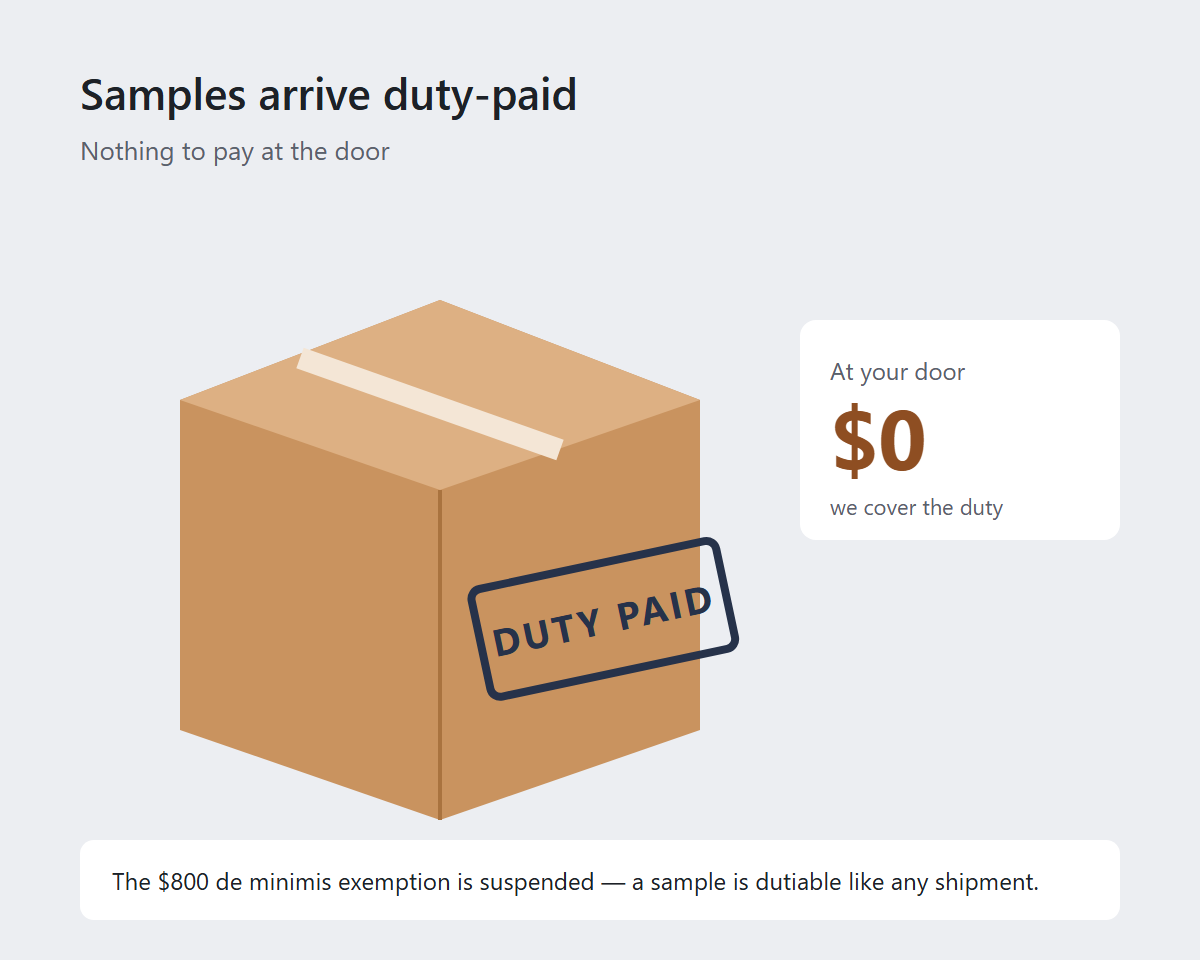
We pay the duty on samples ourselves, so a sample arrives with nothing to pay at the door. Samples cost $149 for leather, $139 for varsity or satin and $99 for a hoodie, take about 14 days to your door, and the fee is credited in full against your first order. See how a sample works.
DDP or duty unpaid: a worked comparison
Suppliers quote on different terms, and the terms decide who pays what at the border. Two are worth knowing:
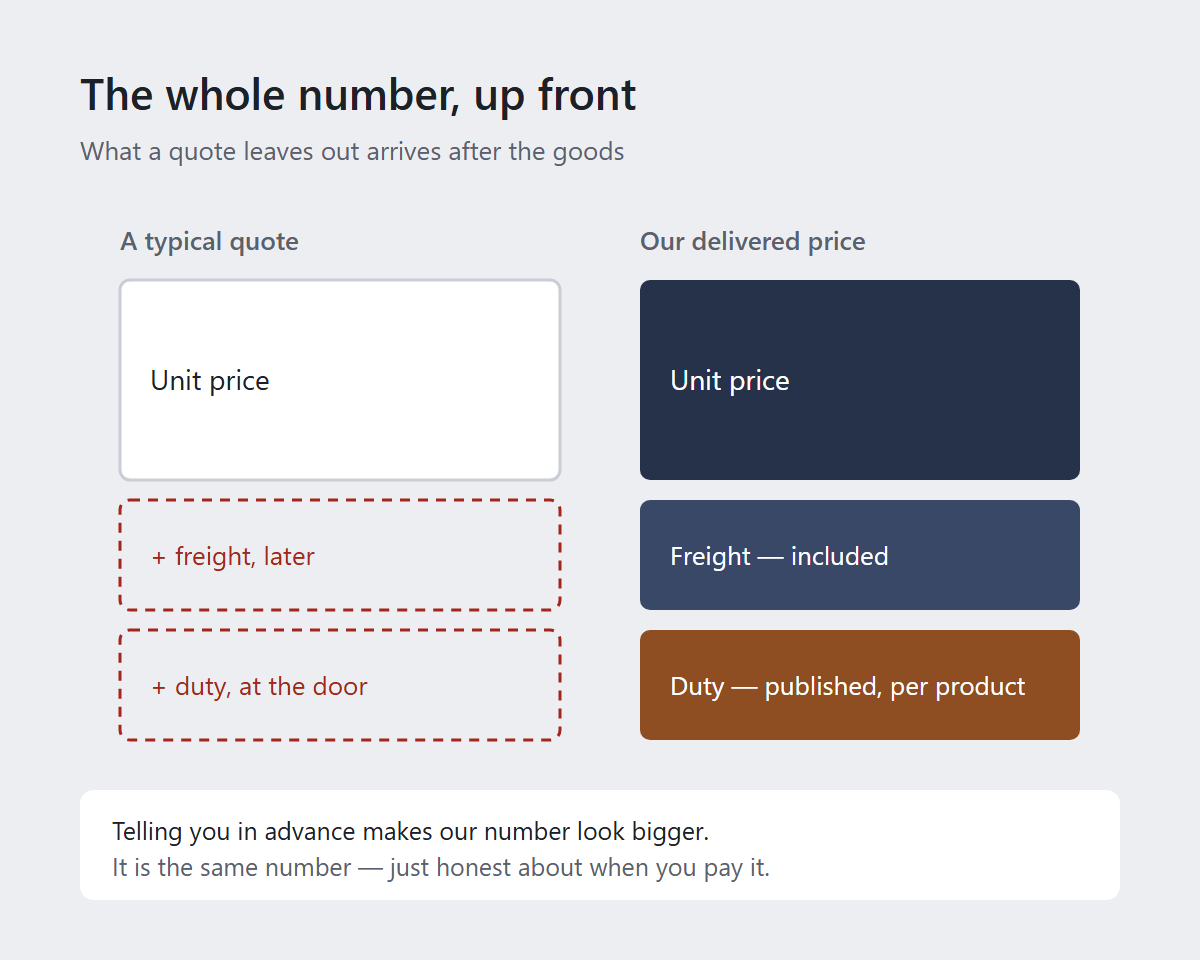
- DDP (delivered duty paid). The seller delivers to your address and its side handles customs clearance and pays the duty. You pay one price; nothing is collected on arrival.
- DAP (delivered at place), often called duty unpaid. The seller pays freight to your address, but import duty and clearance charges are yours, payable when the goods arrive.
A low unit price on any other terms, such as ex-works or FOB, leaves freight to you as well. That is the subject of our landed cost guide, so we will not repeat it here.
We publish both prices side by side so you can compare them directly. Here are 50 pieces of each product:
| 50 pieces | Duty unpaid, per piece | Est. duty | Unpaid + duty | All-in, duty paid |
|---|---|---|---|---|
| Leather jacket | $85 | 16% = $13.60 | $98.60 | $102 |
| Varsity, wool melton | $95 | 30.5% = $28.98 | $123.98 | $127 |
| Satin jacket | $95 | 37.7% = $35.82 | $130.82 | $134 |
| Hoodie | $52 | 26.5% = $13.78 | $65.78 | $68 |
Take the leather row. On the duty-unpaid price you pay $85 a jacket, then about $13.60 in duty at the border, which brings you to roughly $98.60 before any broker or courier fees. The all-in price is $102 with nothing to pay on arrival. The difference of a few dollars a jacket is the cost of having someone else clear the goods and carry the risk of a surprise.
A note on the arithmetic: US duty is normally assessed on the customs value of the goods, which usually excludes international freight, so the real figure on a duty-unpaid order can come in slightly lower than the table shows. Applying the rate to the full price gives you a cautious number to plan with.
Rule of thumb
If you already have a customs broker and import regularly, duty unpaid can save a little. If this is your first import, the all-in price removes the one charge that usually arrives unannounced.
Who is the importer of record
The importer of record is the party legally responsible for the goods entering the US: declaring them correctly, classifying them, and paying the duty. If the classification is wrong or the value is understated, the importer of record answers for it, sometimes long after the goods have been sold.
On a duty-unpaid shipment, that is normally you, either directly or through a broker acting for you. On a DDP shipment, the seller’s side arranges the clearance and pays the duty. Either way, ask the supplier in writing who is named on the entry. It matters if you ever need to return goods, claim a refund of duty, or answer a question from customs.
One practical point: commercial shipments valued above $2,500 generally need a formal entry, which requires a customs bond. A broker can arrange a single-entry bond or a continuous one if you import often.
Customs brokers and the small fees around them
A licensed customs broker files the entry on the importer’s behalf. Express couriers act as brokers for the parcels they carry, which is why a courier can ask you for duty before it delivers. If you clear goods yourself on a duty-unpaid basis, expect some of these on top of the duty:
- Brokerage or entry fee for preparing and filing the entry.
- Disbursement or advancement fee when the courier pays duty for you and charges you back.
- Merchandise processing fee, a small government fee on formal entries charged as a percentage of value, with a minimum and maximum.
- Bond cost on formal entries.
- Storage if the goods sit at a warehouse waiting for paperwork.
Each is small on its own. Together, and unannounced, they are how a planned margin quietly shrinks. On the all-in price these are our problem, not yours.
Air or sea: how freight changes your timeline
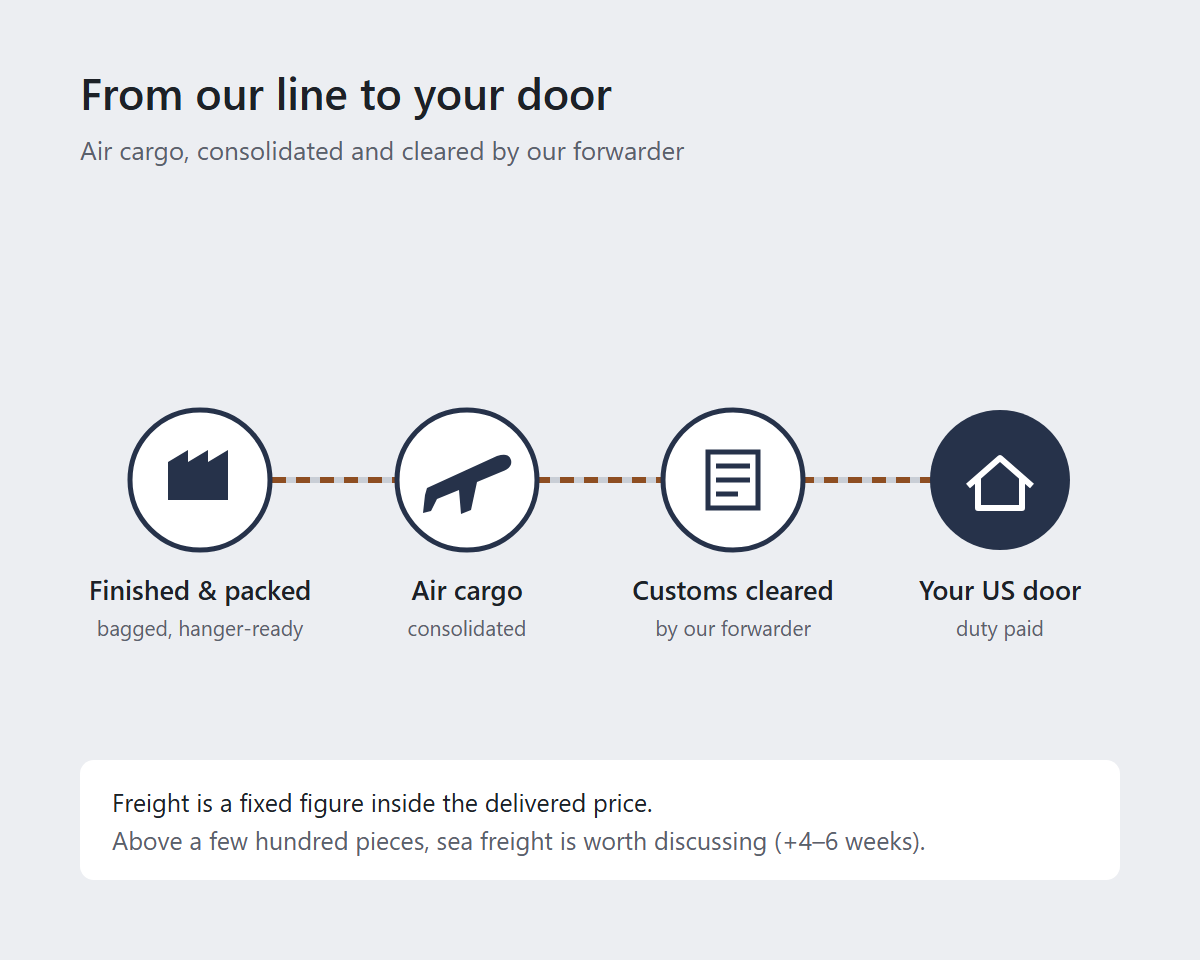
Freight mode decides how long your money is tied up before you can sell. Air cargo is faster and suits most orders up to a few hundred pieces. Sea freight is cheaper per kilo at volume but adds weeks, plus time at port and inland delivery.
| Stage | Published time to your door | How it ships |
|---|---|---|
| Sample | about 14 days | Air, duty-paid |
| 5 to 50 pieces | about 4 weeks after sample approval | Air cargo, consolidated and cleared |
| 200+ pieces | about 6 weeks | Air cargo, consolidated and cleared |
| Several hundred pieces and up | add 4 to 6 weeks | Sea freight, worth discussing |
Our published times are to your door and already include production, transit and customs clearance. Freight is a fixed figure inside the delivered price, so a move in freight rates between your order and your shipment does not change what you pay. More detail is on shipping and duty.
How to budget landed cost
Landed cost is everything it takes to get one sellable jacket onto your shelf. The landed cost guide linked above covers the parts in detail; here is the order to work in when you are planning a first import:
- Get the delivered price per piece at your quantity, in writing, and the terms it is quoted on.
- Get the HTS code and the total duty rate for the exact garment, from that supplier’s country.
- If the price is duty unpaid, add duty at that rate to every piece. Use the full price for a cautious figure.
- Add a line for broker, handling and courier fees if you are clearing the goods yourself.
- Add your own costs: platform or marketplace fees, payment processing, packaging inserts and outbound shipping.
- Divide by the pieces you expect to sell at full price, not the pieces you ordered.
- Check the result against your retail price. If the margin only works with nothing going wrong, change the quantity, the fabric or the price before you order.
Our pricing page has a calculator that runs on the published prices and the duty rate for your garment.
Mistakes first-time importers make
- Pricing retail off the unit price. Freight, duty and fees come after. Price off the delivered, duty-paid figure.
- Assuming small parcels are duty-free. That ended in August 2025. Samples and small orders are dutiable.
- Choosing a fabric on unit price alone. Polyester satin costs less to make than wool melton and can cost more to import.
- Accepting a vague product description. “Jacket” is not a classification. A wrong or thin description invites delays and reclassification.
- Undervaluing the invoice to cut duty. It is illegal, and the importer of record carries the penalty.
- Not asking who clears the goods. If nobody has arranged clearance, the shipment waits, and storage charges start.
- Paying a first order by bank transfer to a stranger. Pay by card on a first order so the chargeback protection is yours.
Questions to ask any supplier
Whoever you buy from, these questions sort careful suppliers from vague ones. A supplier who has shipped to US buyers before will answer all of them quickly.
- What is the delivered price per piece to my address at this quantity, and on what terms: duty paid or duty unpaid?
- What HTS code applies to this garment, and what total duty rate, including any additional duties for your country?
- Who is the importer of record on the entry?
- Who clears the goods, and will anything be collected from me on arrival?
- How does it ship, and is the delivery date to my door or to the port?
- Are freight costs fixed in the price or billed at cost afterwards?
- Will you confirm the duty rate in writing before I pay?
- What are the payment terms, and can I pay by card?
- What happens if the order does not match the approved sample?
Our answers are published: the rates and codes on our shipping and duty page, terms on payment and terms (50% at order, 50% before shipping, card or bank transfer), and what happens if something is wrong on the remake policy.
Two jackets that look alike on a product page can sit in headings with very different duty.
Summary and next steps
- The HTS code sets the base duty; the country of origin adds or removes duty on top of it.
- Leather jackets are around 16% from Pakistan today; polyester satin is around 37.7%.
- The $800 de minimis exemption is suspended, so samples and small orders are dutiable.
- DDP means one price with duty inside it. Duty unpaid means you or your broker clear and pay on arrival.
- Ask who the importer of record is, and get the rate confirmed in writing before you pay.
Duty rates are estimates at current US rates and depend on the finished garment’s materials, so confirm your exact rate for your product. We confirm yours in writing before you pay. If you are selling online and want the numbers for your own jacket, see for sellers or ask for a delivered price.
