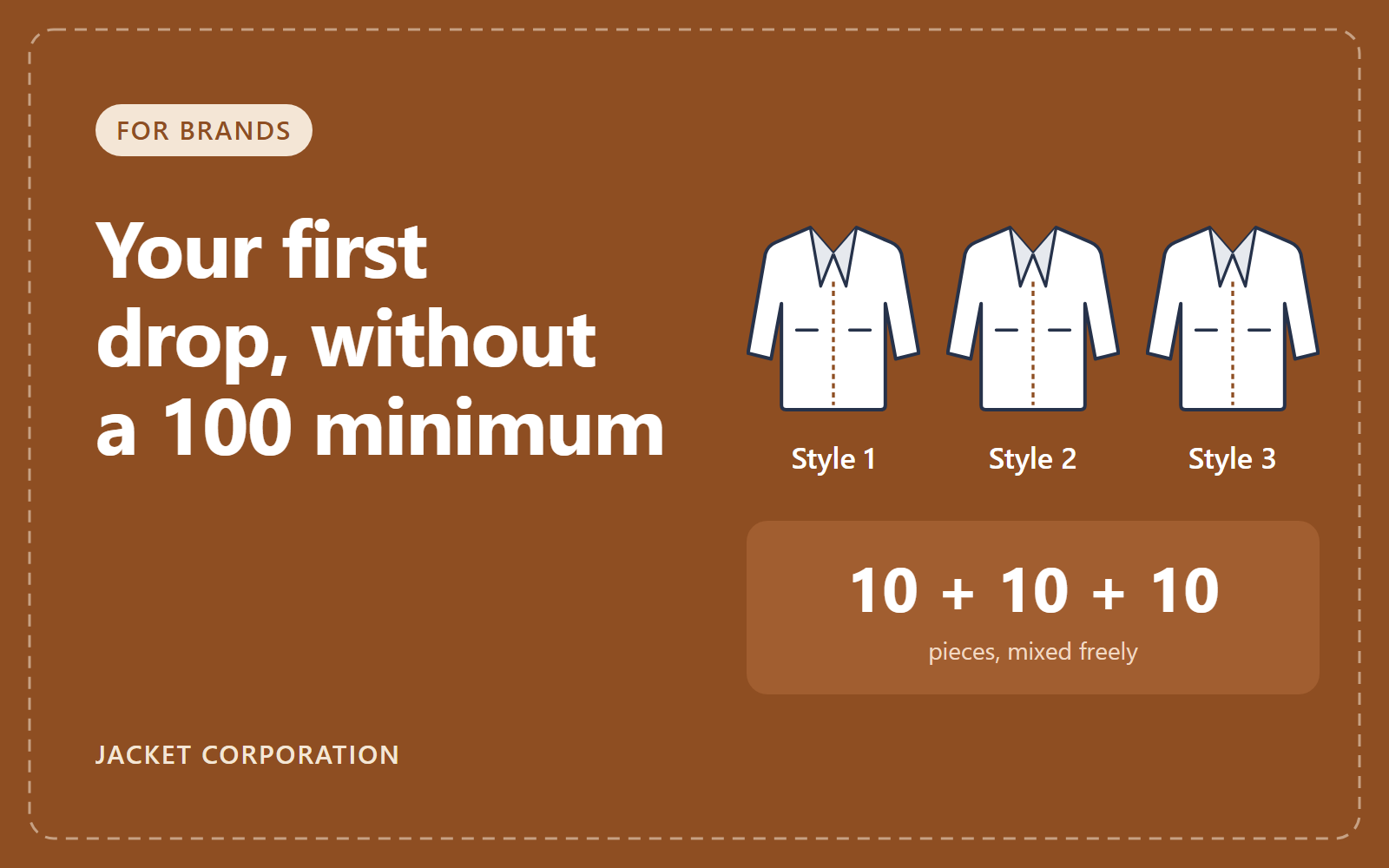
You have three to five jackets in your head, a sketchbook or a folder of photographs, and a rough launch date. Then the first factory quote arrives: 100 pieces per style, per colour, a tech pack before they will talk, and a sampling bill up front. Three styles at that minimum is 300 jackets before you have sold one.
This guide is for the founder who wants to test a collection with real customers before betting everything on it. It covers why minimums exist, what a small first drop actually costs, how long it takes week by week, how to protect the design, and how to judge leather you cannot touch. The numbers are our published prices, so you can check the arithmetic yourself.
Why factories set minimums, and what that means for you
A minimum order is not arbitrary. Every new style carries fixed work that does not change with quantity: drafting the pattern, grading it into sizes, cutting test panels, setting up the machines, sourcing a hide colour and briefing the line. A factory that spreads that cost over 300 pieces can quote a low unit price. Spread over 10, the same work makes each piece expensive, so many suppliers simply refuse small runs.
There is also material buying. Leather is sold by the hide and by the lot, and a tannery may want a minimum dye batch for a custom colour. Hardware and branded trims have their own minimums. A factory that has to buy a full lot of something for your order passes that on as a minimum.
For you, this means two things. First, a supplier with no minimum still has those fixed costs; they are either built into the sample fee or into a higher unit price at small quantities. Look for where they sit. Second, the cheapest per-piece quote is rarely the cheapest launch. A $70 jacket you must buy 300 of costs far more than a $114 jacket you can buy 30 of, and unsold stock is the most expensive thing a new brand can own. Our guide to minimum order realities goes deeper on this.
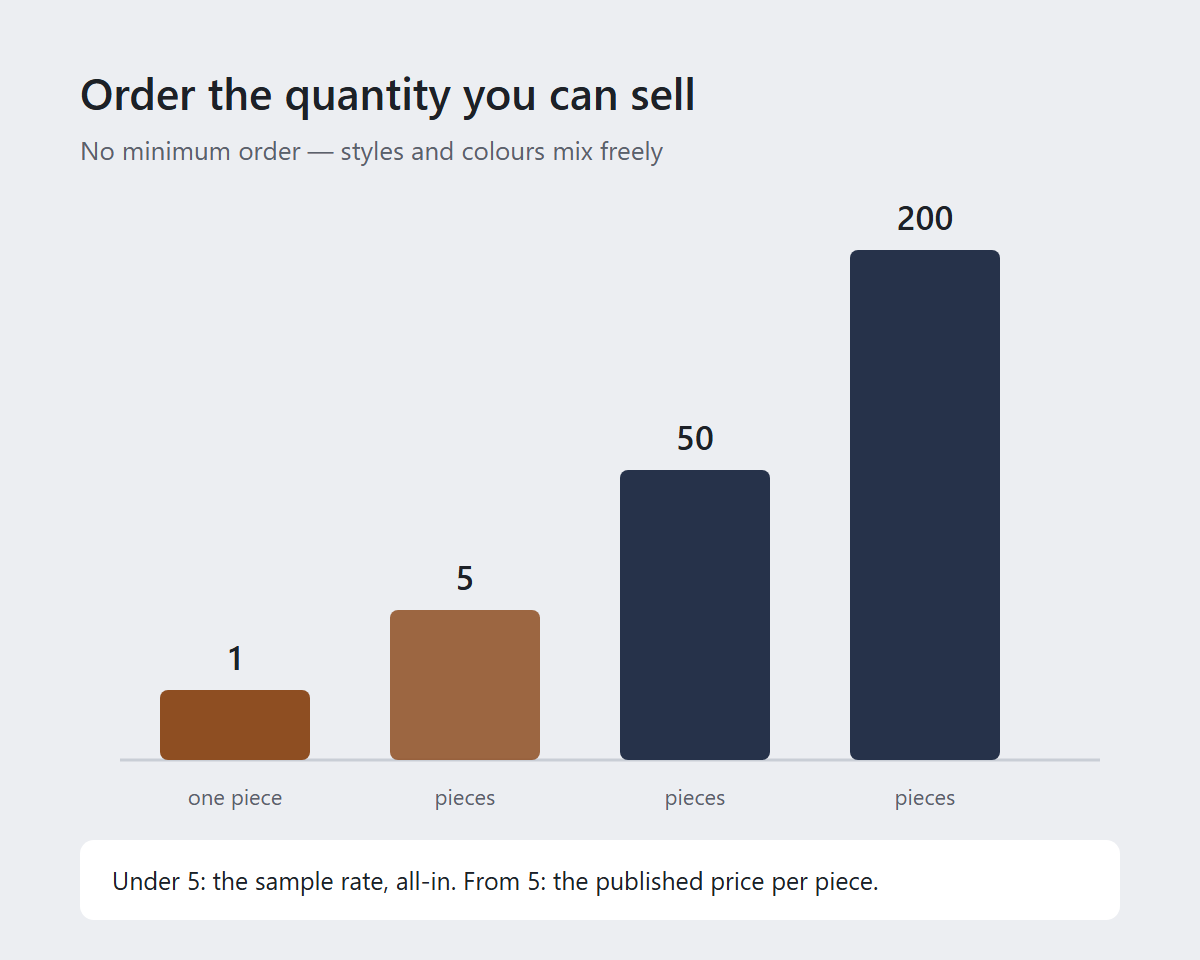
How it works on our line: there is no minimum order. One piece is fine, and styles and colours mix freely. Under five pieces you pay the sample rate per piece ($178 leather, $186 varsity, $129 hoodie, all-in). At five pieces and above the published delivered price applies, and it drops again at 50 and 200. Quantity can be counted per style or across the order, whichever suits you.
A realistic budget for a first drop
A first drop has two cost blocks: one sample per style, and a small production run once the samples are approved. Our sample fees are $149 for leather, $139 for varsity or satin and $99 for a hoodie. Each includes pattern-making, arrives duty-paid in about 14 days, and is credited in full against your first order. The production prices below are all-in: freight to your US address and US duty included, nothing to pay at the door. Full tables are on the pricing page.
| Product | Sample | 5–49 pcs, each | 50–199 pcs, each | 200+ pcs, each |
|---|---|---|---|---|
| Leather jacket or vest | $149 | $114 | $102 | $95 |
| Varsity, wool melton | $139 | $141 | $127 | $119 |
| Satin jacket | $139 | $148 | $134 | $126 |
| Hoodie or fleece | $99 | $77 | $68 | $63 |
Worked example: three styles, ten of each
Say your first drop is a leather jacket, a varsity and a heavyweight hoodie, ten of each in a spread of sizes.
| Line | Amount |
|---|---|
| Samples: leather $149 + varsity $139 + hoodie $99 | $387 |
| Leather jacket, 10 × $114 | $1,140 |
| Varsity, 10 × $141 | $1,410 |
| Hoodie, 10 × $77 | $770 |
| Production order total | $3,320 |
| Sample fees credited against the order | −$387 |
| Balance on production | $2,933 |
| Total cash out, samples and production | $3,320 |
Because the sample fees come off the order, the total you spend on the drop is the production total: $3,320 for 30 finished, labelled, bagged jackets and hoodies at your door. If one style needs a second sample round, add one more fee (the same as the first) to keep your budget on the safe side: $149 for a leather jacket.
Worked example: three leather styles, fifteen of each
An all-leather drop of a biker, a bomber and a cafe racer at 15 pieces each is 45 jackets at $114, or $5,130. Three leather samples are $447, credited back, so the balance on production is $4,683. Payment runs 50% when you place the order and 50% before shipping, so the cash leaves in stages rather than in one bill. On a first order, pay by card: the chargeback protection is yours. See payment and terms.
Rule of thumb
Budget one sample per style, plus one spare round for the style you are least sure of. With fees credited, the production total is close to your total spend.
Leave room in the budget for things that are yours to pay: product photography, your store, shipping to customers and the platform fees on each sale. Work out margin per piece before you set retail prices, not after.
Choosing what to launch first
Three to five styles is enough to look like a brand and few enough to sample properly. A few rules help choose them.
- Lead with the piece you are surest of. The one you can describe, price and photograph in your sleep. Order more of that one.
- One hero, one alternative, one entry price. A leather jacket as the hero, a varsity or satin as the alternative, a hoodie as the piece more people can buy.
- Keep colours tight. Two colourways of one style tell you more than one colourway each of four styles.
- Order the sizes you will sell. For most menswear, M, L and XL carry the run; XS and 3XL are a piece or two each, or skip them in drop one.
- Change one variable from a known shape. Starting from an existing catalogue style and changing the leather, colour or details often saves a sample round.
Week-by-week timeline from brief to launch
The published lead times are sample about 14 days to your door, and 5–50 pieces about four weeks to your door after sample approval. Here is how that stacks up for a first drop, including one second sample round.
| Week | What happens | Your job |
|---|---|---|
| Week 0 | Brief sent; NDA signed first, same working day | Send sketches, photos, reference jacket, target price |
| Week 1 | Patterns drafted (days 1–3); swatch photos sent (days 2–4) | Choose leather, lining, hardware, colours |
| Week 2 | First samples arrive, duty-paid | Wear, measure, photograph, write fit notes |
| Weeks 3–4 | Second round on any style that needs it (+14 days) | Start product photography plans and store setup |
| Week 5 | Samples approved; order placed, 50% paid | Lock sizes and quantities per style |
| Weeks 5–8 | Production, six-stage QC, photographs before shipping | Pay the second 50% before shipping; build pre-launch list |
| Week 9 | Order at your door | Check every piece, shoot product photos |
| Weeks 10–11 | Launch | Go live with stock in hand |
Two weeks of buffer between delivery and launch is worth keeping. Photographing real stock beats launching on sample photos, and it gives you time to deal with any piece that does not match.
Protecting the design
Your design is the one thing a small brand really owns, and you are about to hand it to a supplier you have not met. Protect it before you send anything.

- Get a mutual NDA signed first. We offer one before you ask and sign first, the same working day. If you have your own, send it.
- Get ownership in writing. Your pattern should be used for your orders only: never for another customer, never in another colour for someone else, never as a stock design.
- Ask about deletion. You should be able to ask for your files to be deleted. Ours are deleted within seven days on request.
- Keep your own record. Date your sketches and keep the email trail. An NDA is easier to rely on with evidence of what you sent and when.
An NDA does not make copying impossible, but it sets clear terms and makes a supplier think twice. The full terms are on our design ownership page.
Judging leather and finish remotely
You cannot squeeze a hide over email. You can still make a sound choice from photographs and one physical sample if you know what to look for.

- Swatch photos in daylight, side by side. One photo with all options together shows relative colour far better than separate images.
- A bend shot. A swatch folded over shows how the surface creases and whether the finish cracks.
- Know the leather type. Lambskin is soft and light; cowhide is heavier and tougher; aniline shows natural marks; semi-aniline is more even. Our leather grades guide explains each.
- Judge the sample, not the photo. The first sample is where you feel weight, drape, smell and stitching. Hold it in daylight and check seams, edges and lining.
- Expect natural variation. Grain differs from hide to hide. That is leather, not a defect, within the tolerance you agree.
Fit approval
Fit is where first drops go wrong, and returns from bad sizing eat margin fast. Treat the sample as a measuring exercise, not just a try-on.

- Put the sample on someone who wears the sample size, usually a medium. Photograph front, back and side, arms raised and lowered.
- Lay it flat and measure chest, length, sleeve and shoulder. Compare with a jacket you already know fits well.
- Write fit notes in numbers: “sleeve 2 cm longer”, not “sleeves feel long”.
- Send photographs and numbers together. If a second round is needed, it costs the same as the first and is normal.
- Once approved, that sample is the standard. Sizes XS–3XL are graded from it, and finished measurements are checked to ±1 cm.
Mistakes first-time founders make
- Too many styles, too few of each. Five styles at three pieces each tells you little about what sells, and spreads your sampling budget across five patterns.
- Changing things after approval. A change mid-run needs a new sample. Make every decision on the sample.
- Approving from photos only. Always hold a physical sample before production.
- Ignoring duty. A duty-unpaid price looks cheaper until the bill arrives. Compare all-in prices; leather jackets carry an estimated 16% under HTS 4203.10.40. See shipping and duty.
- Launching on a date with no buffer. Build in the second sample round and two weeks after delivery.
- Paying everything up front by wire to a new supplier. Staged payment and a card on the first order protect you.
Questions to ask any manufacturer
Whoever you work with, these questions show quickly whether a small first drop will be handled well.
- Is there a minimum per style, per colour or per order, and what happens below it?
- What does a sample cost, does it include pattern-making, and is the fee credited against the order?
- Is the quoted price delivered to my door, with freight and duty, or ex-factory?
- How many sample rounds are normal, and what does a second round cost?
- Will you sign an NDA before I send the design, and who owns the pattern?
- What is checked in QC, with what tolerances, and will I see photos before it ships?
- What happens if the order does not match the approved sample?
- What are the payment terms, and can I pay by card?
- How fast can a reorder start once a style sells?
The cheapest per-piece quote is rarely the cheapest launch.
Summary and next steps
A first drop does not need 300 jackets. It needs three to five well-chosen styles, one approved sample each, and a small run you can sell through. With published prices, a three-style drop of ten pieces each comes to $3,320 delivered, and about nine to eleven weeks from brief to launch. Protect the design with an NDA first, judge leather on a real sample, approve fit in numbers, and reorder what sells: a reorder skips sampling because your pattern and approved sample are on file.
When you are ready, order a sample of the style you are surest of.

